Showing posts with label death. Show all posts

Wednesday, May 2, 2012

The Mathematics Of Maceration - A HowTo Guide For The Patient


I am constantly being asked how long maceration takes and replying "There is no set equation". So I thought it was time for this blog post for some clarification.

It takes as long as it takes. There are a lot of factors that can change the amount of time from start to finish. Time of year, location, size of remains, amount of remains, type of remains, how much flesh/hide is on remains, etc.

Maceration is my preferred method of cleaning bones of flesh, ligaments, soil, etc. It is one of the most gentle methods to use if you want strong, solid bones as the end result. It is literally a form of rotting or putrefaction. Where bacteria removes proteins from the bone. Simply by putting the carcass remains into a sealed container of water.

But it also takes patience. Lots of it. Here are images to explain.

Opting Out Of Huffing Death

Be safe, be sanitary! I always wear latex gloves when handling the early unsanitary steps of bone processing. Likewise, I prefer to wear a respirator when switching out maceration baths and pulling off tough stuck on skin and hide. That way I can work with it more slowly and carefully rather than rushing it because of the smell.
The Mathematics Of Maceration - A HowTo Guide For The Impatient
(click for larger image)

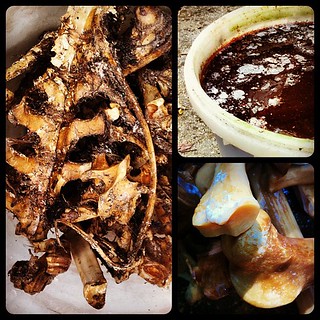
First Image - Nature/insect cleaned deer and wild boar bones with minimal amount of flesh/ligaments/etc. Added to maceration tub. Was filled to the top with water. Then tight fitted lid was replaced. You don't want any big chunks of flesh or pieces of hide/fur/feathers in your maceration tub. Try to remove as much as you can before you begin this process.

Second Image (top) - 3 weeks later the water in the tub was a rusty brown color. This is a good thing. Means the bacteria are doing their work to remove the fleshy bits. Water was NOT switched out that entire time. Sometimes I prefer to switch out the water now and then as it gets cloudy... say once ever other week. Depends on what I have soaking and time of year. As the oils rise to the top of the water and flesh falls off to the bottom, the water will become incredibly nasty/smelly. As it does, pour it out and replace with new clean water. The rule is that once the water is clear, you're done.

When it is colder it slows down the process. It will work best if kept in a warm location. I've read that maceration works best between 35°C/95°F and 50°C/122°F. I'm located in Florida so I can just leave my big maceration tubs sealed outside year round. The process just really slows down through the Winter.

Third Image (bottom) - There are still some meaty bits on the bone and some of the vertebrae were still attached. So not done yet. Threw them back into the bucket and added water and lid again. Takes as long as it takes. Bone processing takes patience. If you are impatient get several projects going in rotation at once. I usually have all stages of the bone cleaning process going at all time. If you are always messing with the bones or worst, cooking them because you're impatient... you are likely damaging them. True story.

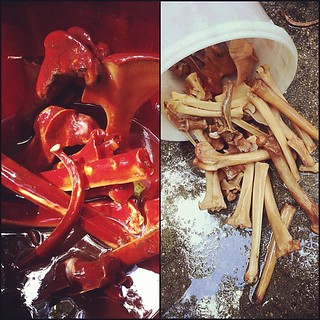
Here's another maceration batch example image:
That Gore Cleaned Up Nicely - That's Actually A Bright Red Bacteria & Not Blood

I left this similar batch of bones soaking for at least a month without switching out the water once. It wasn't planned, I was just busy and forgot. The water had turned this amazing blood red color. The bones rinsed off quite nicely and didn't need to macerate any longer.

They did however smell pretty awful. So I put them into a fresh batch of water with some dish soap to help get rid of the smell and to further degrease the bones. Larger bones like these deer/wild boar pieces take a bit more time to degrease. Some animals also seem to have more grease saturated into their bones.

Next step is to sanitize and whiten. Remember, do NOT use chlorine bleach, only hydrogen peroxide. Check out my blog post Bad Words: BLEACH & BOIL for more bone processing HowTo info about this.

---

PRECAUTIONS ABOUT MACERATION ADDITIVES

Some people do use cleaning agents/detergents in their maceration baths to accelerate softening of the flesh and/or encourage grease to come out of the bones. However, I do not. In my experience adding anything manmade to the mix is only chancing weakening the bones. So the below info is just for informational purposes. I do not endorse any of these products.

Sal soda (sodium carbonate) is a water softener that some people use to accelerate softening of the flesh.

Biz is an enzyme-based bleach. Which makes me hesitant to use it personally. But I've had others tell me it works for them.

Oxiclean is a detergent and bleaching agent. I was told it does NOT work very well. Not only did it not get the fatty residue off of the bones but it also DISSOLVED some entire bones!

Borax (sodium tetraborate) is a laundry booster and will turn your bones to mush. So do not use it!

Vinegar will literally turn your bones rubbery. You don't ever want to use it in any step of processing.

The way maceration works is that living bacteria is in the water removing the flesh from the bone. If you put any sort of additional chemical or soap in the water that would likely kill bacteria rather than promote their growth. That just seems counteractive to me.

If you read through the maceration HowTo guide of one of today's biggest bone companies that specializes in selling high quality bones, you'll see they just use water. Nothing more. That to me says all I need to know. See for yourself, here is The Bone Room.

I'll just close with that thought.

Thursday, April 14, 2011

Starting Over, Learning Anew

IMPORTANT NOTE: At the time I wrote this blog post I was unaware that it is actually illegal here in the US to walk train tracks or even be within a certain distance of them unless you're crossing at a designated public crosswalk. While these particular tracks I was on were no longer used, walking on tracks still in use is incredibly dangerous. Please stay safe while collecting!

So I've been going through a bit of culture shock the last several months. I moved from deep in the undisturbed country to the middle of where I honestly thought I'd never find myself again... suburbia.

I went from no neighbors, fences or paved roads ... to prying eyes, having to hear the business of others at any given moment and pretty much an entire lack of privacy. I can't even seem to go outside most days to enjoy some fresh air without someone wanting to know who I am or what I'm doing.

I previously lived in nearly pure privacy for over 8 years and didn't talk to anyone unless I wanted. Don't get me wrong I'm exceptionally friendly. Especially with complete strangers. Most times I'm standing in line at the grocery store or post office I start talking to someone else in line.

But my privacy and freedom have always been very important to my well being... and now I rarely have either.

As a person that collects the remains of animals to use in art, jewelry or for display... my life has become especially limiting. And I have to relearn many things because of these new limits.

Before, I could have an entire deer carcass on my property and nobody would flinch at the smell. Now, anything larger than a squirrel would attract far too much attention from the 4 neighboring houses so closely backed up to the short chain linked fence.

So far, all carcasses I've put in the back yard have been taken by an opossum or raccoon. So I have to figure out how to resolve that without having a big cage like I did in the country. That's not something that's socially accepted by the neighbors here I'm sure. Plus, there are small children in the yard. That's right, I'm also trying to adjust to being an instant Mommy figure... to twin 3-year-old girls. My boyfriend's girls.

For a suburban area there is an abnormally large amount of nature here compared to say where I grew up. I'm especially in awe with the low flying vultures everywhere. I find myself trying to make a mental note of where I see them roadside eating roadkill. In hopes of coming back to get the remains.

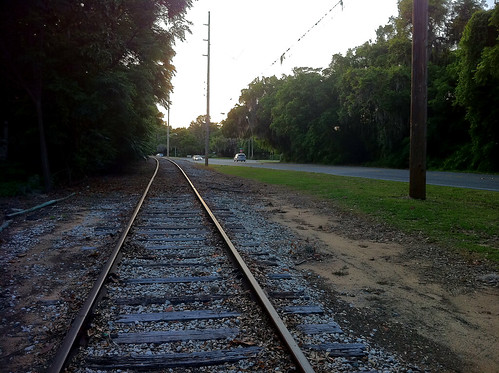
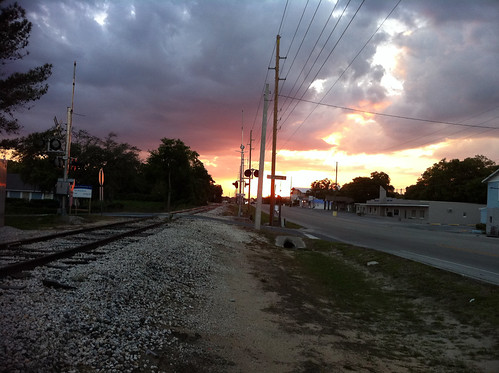
I did just that recently when I hopped onto my bike with many plastic bags in tow. I went alongside train tracks that also ran parallel a main two lane road into the center of town. I headed out fairly late in the day to minimize the heat and sun.

BONELUST - Along the Tracks View

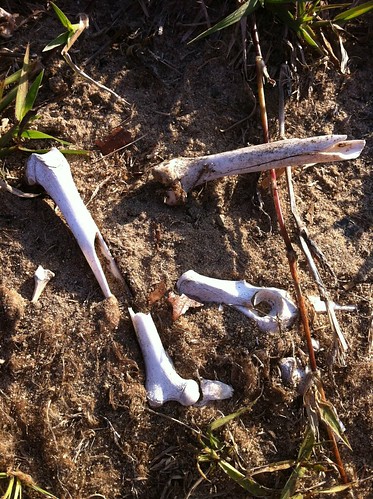
Within five minutes I found the remains of the opossum I saw a vulture eating weeks previous. If only I had got to them before the big city lawnmowers they' be in better shape and the skull might still be around.

BONELUST - Along the Tracks: Opossum Bones

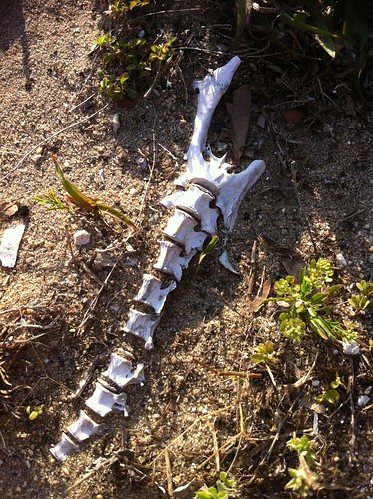
There had also been a lot of severe thunderstorms and tornados in the area so much of the smaller remains were lost in the sand.

BONELUST - Along The Tracks: Opossum Spine

This particular area was covered with hundreds of tiny armadillo bone plates (or osteoderms). But just too many and too small to pick up.

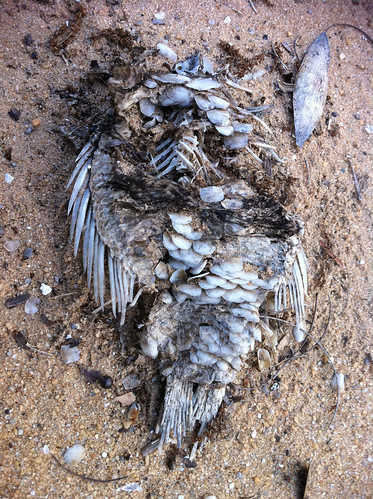
Just beyond this I found what I thought at first was the spine and ribs of a small mammal. But then realized it was a small part of the remains of a fish skeleton. I found four more sets of remains of fish on my trek along the tracks that day. Mostly at the bottom of large telephone poles. Which makes perfect sense because I see Osprey flying overhead frequently with fish in their talons. I imagine they sit atop the poles and eat their catch there before dropping it.
BONELUST - Along the Tracks: Fish

Funny, because only a day earlier a friend brought me the remains of what he thought for sure was a reptile skull. Which I quickly figured out was only part of a large catfish. He found it on a sidewalk in the middle of town so no surprise he didn't think it was a fish.
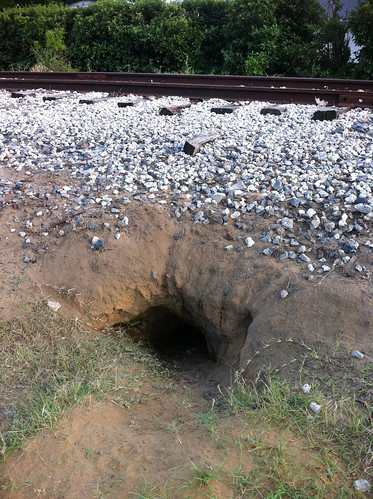
I also saw several animal dens going under the tracks. I wondered what kind of creature lived in them because I saw no fur or tracks.

BONELUST - Along the Tracks: Animal Den

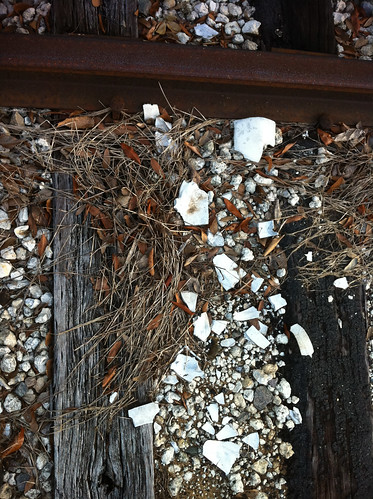
Sadly I think that question was soon answered when I found the remains of what I believe was a large gopher tortoise (which I left since they are a protected species) that looked as if it was traveling down the tracks when it was hit by a train.

BONELUST - Along the Tracks: Turtle or Tortoise Shell

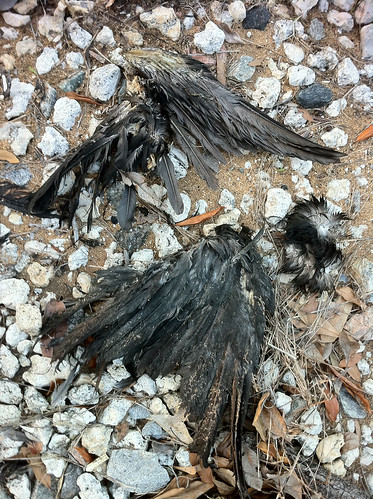
Nearby were the remains of a vulture that appeared to also have been struck by a train.. perhaps while eating the remains of the tortoise.

BONELUST - Along the Tracks: Wings

Amazingly there were only feathers and some skin left behind of the vulture. No head, beak, bones or feet. Something really stripping it clean. Not that I'd pick it up anyway since it is illegal to have, being a protected species of the Migratory Bird Treaty Act.

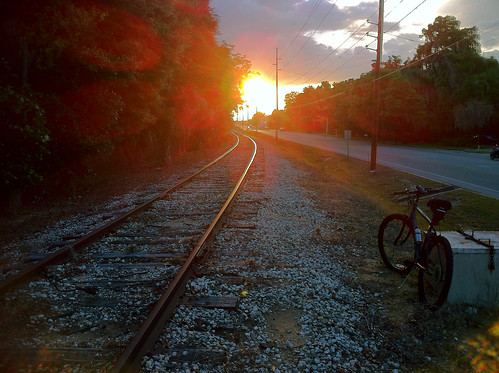
The ride home was quite stunning for suburbia.

BONELUST - Along the Tracks: Sunset & Bike

BONELUST - Along the Tracks: Sunset

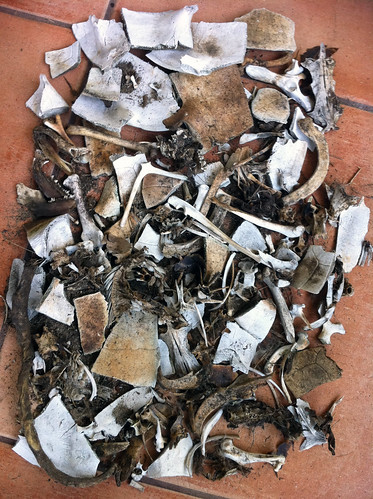
And when I really looked at my bags of loot I didn't do too bad.

BONELUST - Along the Tracks: Finds

The remains of several opossum, 4 various fish, water turtle bones and possibly various cat/dog/raccoon/rabbit/deer bones. I realized afterwards that I need to make this bike ride more frequently if I want to get the remains before they are damage or taken. Plus, there's a LOT more I can explore. This was all found only after a couple miles!

So while I can't process my roadkill finds like I did out in my country home, I do have options. Finding bones mostly flesh free hurries the process and I don't have to have large carcasses in the yard.

I now have these remains in two different sealed containers. One has water and fleshy bones that need to rot off to nothing but bones (maceration). The other has flesh free remains that are soaking in a peroxide bath to whiten. Much of these are already heavily nature cleaned so they won't likely need degreasing.

Fingers crossed this works without a terrible smell coming into the house.

Tuesday, January 5, 2010

The Ones That Got Away - Part 1

Every now and then I come across a great potential bone find. You know, a dead animal. Roadkill, natural death, hunting remains, death by illness, dog treats or in some other form.

Back in April of 2006, I was driving through the back woods near my home with my work crew to do some field work on the Suwannee River. I was driving my car separate because I'd be heading home before the research was done.

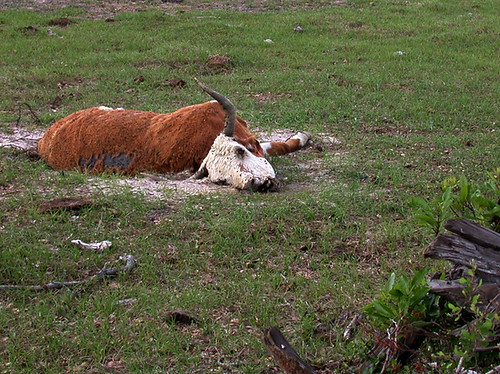
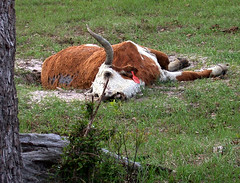
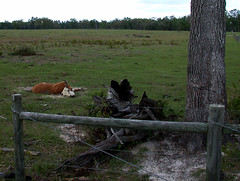
Looking over to the livestock pasture of a local rancher I spotted this:

BONELUST - Dead Cow 5

Right then I knew I'd be back to get photos and try to see if it would be possible to return on a later date for skeletal remains.

BONELUST - Dead Cow 2
Click on photos for larger versions.


I got these photos heading home. Amazingly it didn't reek of death. I wondered what had caused this great beast to die but didn't want to chance getting shot to get a closer look.

BONELUST - Dead Cow 1


Beyond this cow were tiny donkey grazing in the same pasture, and just to the right of this guy was another pasture of cattle.

BONELUST - Dead Cow 3
Note the ear tag.


I found it interesting that it seemed to have died in one of those holes I've seen horses and cattle roll around in. Strangest was that there were no vultures there and not even any circling above. That's unheard of.

The fur patches missing and the way the fur lays says it had been laying there for maybe a week already, and been rained on.

BONELUST - Dead Cow 4


Barbed wire fence = private property. But still, it would be easy to jump this spot to return for the remains but I imagine I wasn't the only person that thought the same thing. It was gone when I came back by.

I'm going to assume the rancher or someone in his family had first "dibs", on that beautiful skull anyway.

I hope to get another horned cattle skull like this again one day. I had one as a child from my grandfather's farm. But it mysteriously vanished along with the rest of my collection one Summer.

Friday, October 9, 2009

Gift Bones - Part 1

Much of my bone collection is found, prepped, and cleaned by myself. Some is bought, and the rest came as gifts from exceptionally understanding friends.

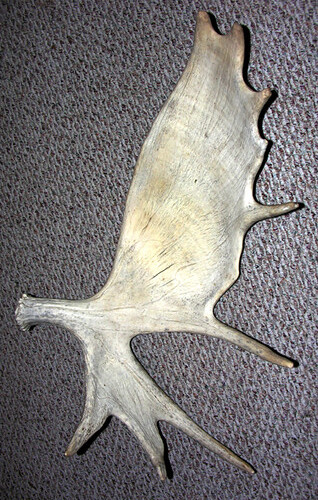
One of the single largest bones I own is this HUGE moose antler which was a gift from my parents. Which came originally from Canada or Alaska, from a male (bull) moose. It was on my wish list of odd items so I was very excited about this surprise gift!

BONELUST - Moose Antler


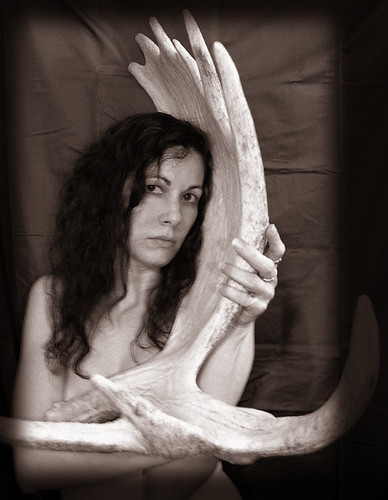
It measures 41 inches across the back curve. And has a pretty good weight to it. Here is a self portrait with it to give you a better idea of how large it is.

BONELUST - Self Portrait with Moose Antler 1


Want to see something really fantastic? Check out The New Hampshire Locked Moose Antler Project. Which involved two moose carcasses found locked in eternal combat turned into a traveling educational taxidermy exhibit. Absolutely stunning. Such a fantastic way to honor these majestic beasts.

With the birth of this blog I started to get "hey do you want a...?." questions more and more often. And of course if it is bone related, I likely welcome what you have to offer. So I started to get some pretty interesting things showing up in my mailbox.

One night while I was out at a show in Gainesville I was located by my friend Will who had some fantastic gifts for me. I love the conversation he must have had with the door guy explaining that he had "something for someone inside".

"Can I just find my friend to give her something?"

"What is it?"


Will lifting the plastic bag with protruding bones.

"A horse skull and a shark jaw."

"Uhhhh sure."


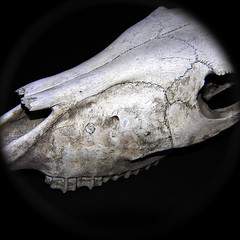
BONELUST - Horse Skull 3


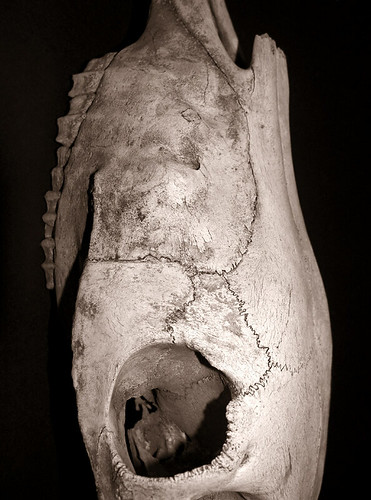
This is one of those cases where I loved the way the horse skull was weathered and won't likely be cleaning it.

BONELUST - Horse Skull 4


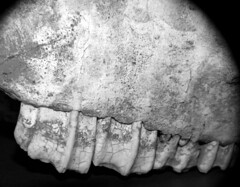
I especially love the cracking of the tooth enamel.

BONELUST - Horse Skull Teeth


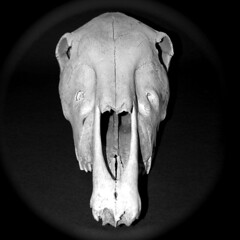
BONELUST - Horse Skull 1


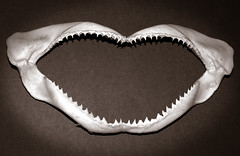
The shark jaw is 10 inches across so it wasn't a very big one. Anyone have any idea what it is from?

BONELUST - Shark Jaws


Thanks so much to my parents and Will for these uncommon gifts!

Stay tuned for more in this series of "gift bones" to come.

Sunday, June 14, 2009

Found Bones - Part 1

I live way out in the country of Florida. There are so many different kinds of wild creatures to be seen in my yard alone. Deer, boar, turkey, rabbits, opossum, armadillo, snakes, frogs, mice, raccoons, owls, woodpeckers, lizards, skinks and on and on.

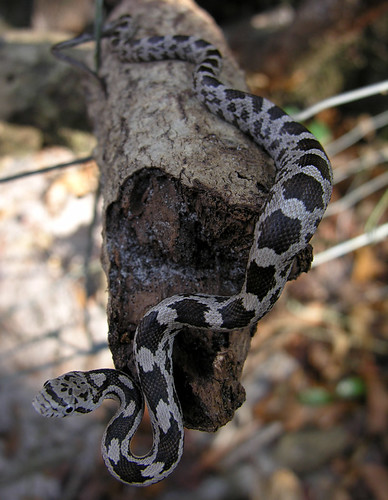
Juvenile Grey Rat Snake - 1
Juvenile Grey Rat Snake.

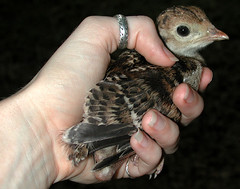
Wild Turkey Chick Saved from my Cat - Meleagris gallopavo
Wild Turkey chick saved from my cat and returned to mother.

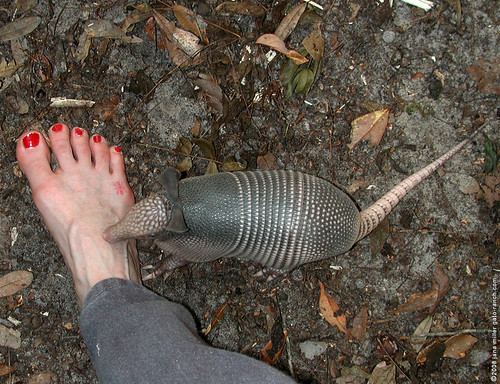
Playing Tag with a Young Nine-banded Armadillo (Dasypus novemcinctus)
Playing tag with a young Nine-banded Armadillo.


Much of the bones in my collection have been found over the years. But once I acquired part feral dogs, they seemed to just appear in my yard. I consider them gifts from my dogs. :)

I find bones fairly regularly in my yard because my dogs, Falcor and Artax, find the remains that hunters throw in the woods... or roadkill.

While I moved out here to be one with nature, much of the original residents here enjoy killing the animals I love to catch a glimpse of. I really don't like hunting but I have also come to realize that a lot of the people that live out in rural areas like this feed their families this way. I imagine there are even more people hunting now with the economy so bad.

From time to time the dogs drag a skull of a wild boar into the yard or I just find remains of the teeth or part of a jaw. This is the largest remains of a boar skull I've found yet. Looks like it has been in the woods for a long time. Wish I knew where my dogs were finding these!

BONELUST - Gift from the Dogs: Really Old Wild Boar Skull

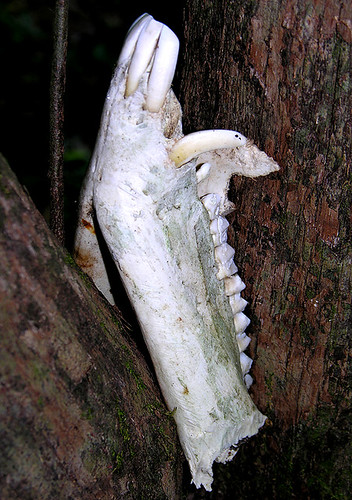
Below is a found Wild Boar jaw that I wedged in between tree limbs. If you look carefully you can see where animals have been gnawing on it for calcium. I have deer antlers outside that they have nearly completely chewed up. This jaw has been here for so long now that the tree is actually growing into it. Amazing.

BONELUST - Found Wild Boar Jaw Wedged in Tree 1

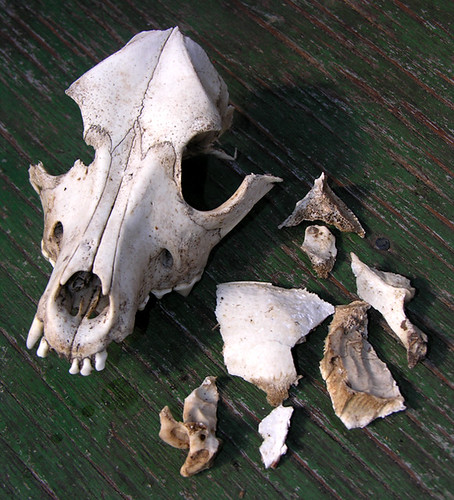
I'm hoping that my dogs didn't kill the dog this skull is from. They had been chewing on it in the yard and broke it. I plan on attempting to glue it back together.

BONELUST - Found Skull & Fragments

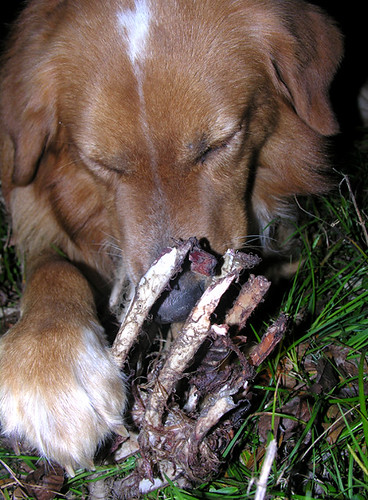
One day I found this huge spine and ribcage in my back yard. It is either from a wild boar or deer.

BONELUST - Deer or Wild Boar Ribcage with Foot as Size Reference

But Falcor wasn't letting me near it for long.

BONELUST - Falcor Claiming the Deer or Wild Boar Ribcage 2

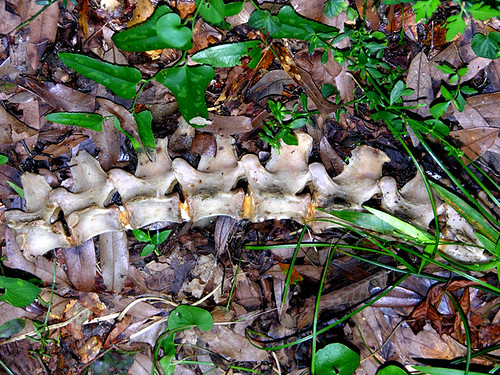
By the next day all that remained was part of the spine. So I tossed it somewhere the dogs couldn't get to and it is cleaning up real nice all by itself.

BONELUST - Spine of Either a Wild Board or Deer

Stay tuned for more in this series of found bones to come.

Tuesday, April 21, 2009

Using Bones in Music: Deer Skull Microphone

This past weekend I had a photo gig at the 49th Electronic SubSouth show, at The Kickstand in Gainesville, FL.

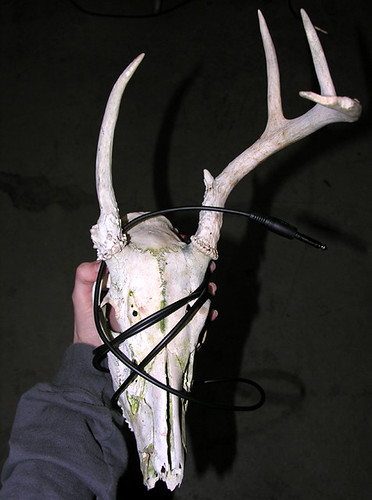
Early in the evening I spotted this deer skull and my brother, Chris, comes up to tell me that this is actually a working mic that one of the musicians that night would be using.

BONELUST - Deer Skull Microphone Top


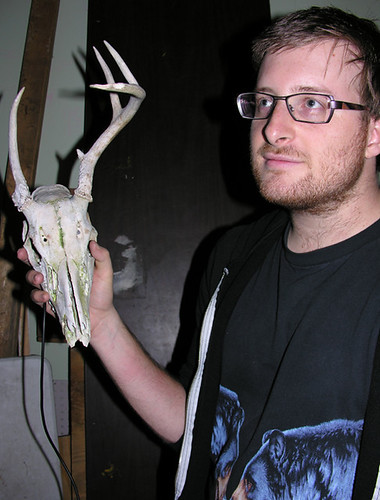
Later on I met him, Dave Armitage AKA No Limit Cycle.

BONELUST - Dave Armitage AKA No Limit Cycle with His Deer Skull Microphone


Turns out he is into the same kinds of stuff my brother and I are. He works with bats and insects for a living AND collects bones. So naturally I was excited about this and wanted to talk to him. Soon after, he told me a really funny story about how he found the skull involving ants and relieving yourself in the woods...haha

I actually missed Dave using the deer skull mic during his performance, because I had to run across town to the Gainesville Skate Park for another show.

I tried to find video of him using it on YouTube but didn't see any. He's apparently only used it a few times. Dave demonstrated for me though, that he actually puts the snout of the deer skull inside his mouth and vocalizes. The actual microphone is way in back of the skull and full of pennies to make additional noises when the skull is shook.

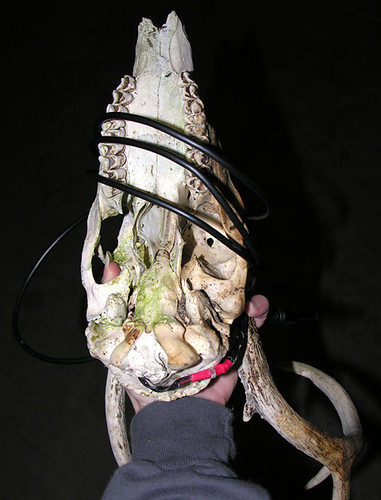
BONELUST - Deer Skull Microphone Underneath


Here is the underside of the skull where you can see the microphone wiring entering the skull. There is a sort of soft putty sealing it inside.

Dave uses other animals bones in his live performance as well. Here is a video of him using a mic'd bone necklace during a live improvisational performance:


Parts of it REALLY remind me of this Scary Sounds of Horror record I had when I was younger. The same one my family blared out the window on Halloween evening! Awesome.

It is very interesting to see bones being used along with electronic music devices. I'll have to be sure to catch No Limit Cycle another time and get live shots of the deer skull mic in use!

Nice to meet you Dave!

Tuesday, April 7, 2009

The Beauty of Death

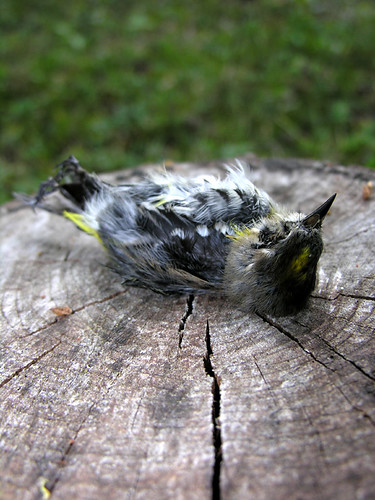
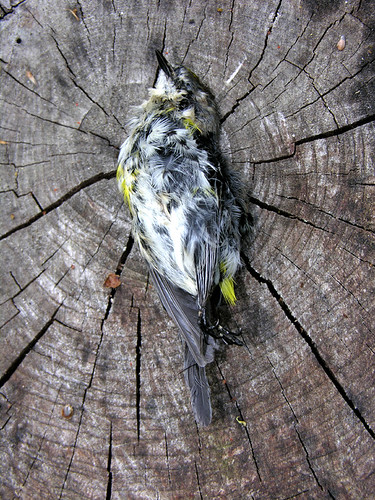
Sometimes death comes quite naturally.

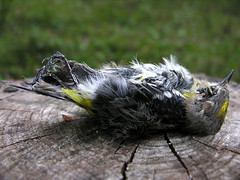
Like this Yellow-rumped Warbler, I found laying beautifully in the yard. I could tell it was not killed by any of my cats or dogs because it remained in full, nearly pristine condition.

(Click on any of the images for a larger view.)

BONELUST - Dead Yellow-rumped Warbler 1

BONELUST - Dead Yellow-rumped Warbler in Hand

BONELUST - Dead Yellow-rumped Warbler 4

BONELUST - Dead Yellow-rumped Warbler 2


The thing about bird remains is that they can stay outside for YEARS and you still may never have a clean skull.

Perfect example being this cardinal head I found long ago that I've had in my "bone box" for all this time.

It just looks more weathered, rained on, and flat now if anything.

BONELUST - Cardinal Head


So I've decided to hang the Yellow-rumped Warbler remains appropriately over my pet cemetery, from an Egyptian scarab beetle amulet instead. I'm hoping the feathers with slowly wash away leaving a beautiful skeleton.

BONELUST - Dead Yellow-rumped Warbler Hanging on Egyptian Scarab Beetle Amulet 2


If it works, I'll have follow-up photos.